Students applying from India, China, Mexico, or Nigeria are facing embassy interview wait times of 300 to 600+ days in 2026. That's the first thing you need to know about the US F-1 student visa — the nominal processing time bears no relationship to when you'll actually get your interview. Apply the moment your I-20 is issued, not a "few months before" your start date.
Quick answer: The F-1 visa costs $535 total ($350 SEVIS I-901 fee + $185 MRV fee). You need an I-20 from your school before you can apply. Processing varies by country — from 2 weeks to 18+ months in high-demand locations. Work rights: 20 hrs/week on-campus during term; OPT for 12 months (STEM: 36 months) after graduation.
What Is the F-1 Student Visa?
The F-1 is a nonimmigrant visa for full-time academic study at a Student and Exchange Visitor Program (SEVP)-certified school in the United States. It's the most common student visa — used by over 1.1 million international students. The M-1 visa covers vocational programmes; the J-1 covers exchange visitors. If you're doing a degree at a US university, you want F-1.
The F-1 doesn't have a fixed expiry date in the way a UK Student Visa does. It expires when your DS-2019 or I-20 expires — which is typically your programme end date plus 60 days of grace period. The visa stamp in your passport has its own expiry date, but that only affects re-entry — not how long you can stay once you're in.
What Is the I-20 Form?
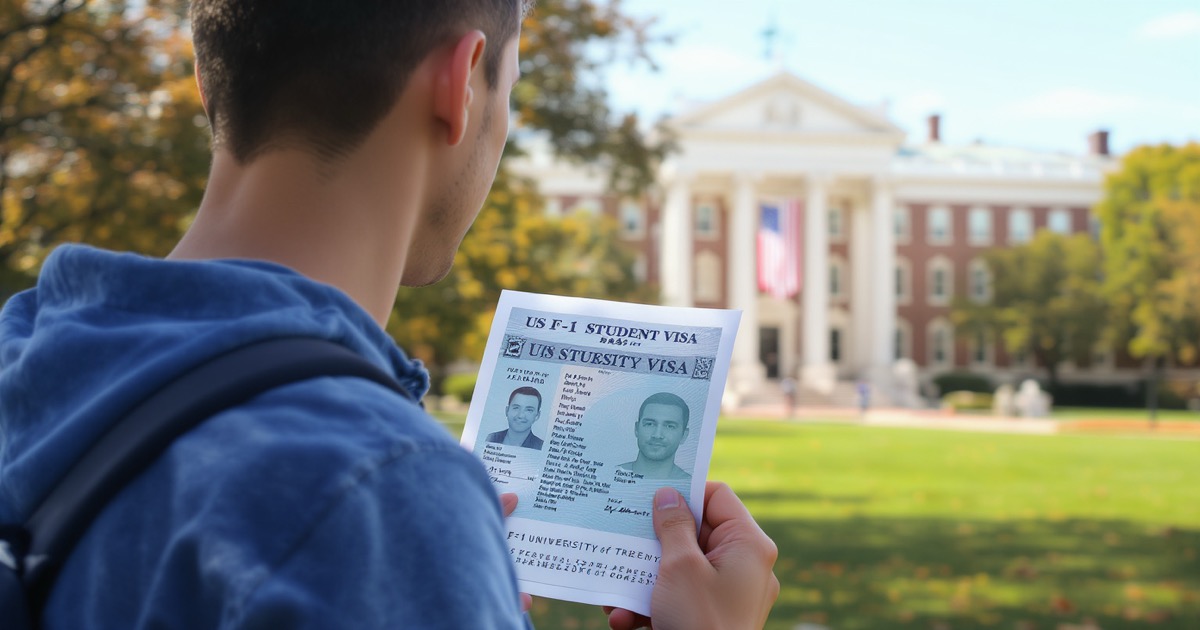
The I-20 is a Certificate of Eligibility for Nonimmigrant (F-1) Student Status. Your school's Designated School Official (DSO) generates it after you're admitted. It contains your personal information, your school's SEVP ID, your programme dates, and your anticipated cost of attendance and funding source.
You cannot apply for an F-1 visa without an I-20. You also cannot pay the SEVIS fee until you have your SEVIS ID, which appears on the I-20. The sequence is: get admitted → receive I-20 → pay SEVIS fee → complete DS-160 → schedule embassy interview.
Check your I-20 carefully: Errors on the I-20 — wrong programme dates, wrong funding amounts, misspelled name — can cause visa denials. Your name on the I-20 must exactly match your passport. Contact your DSO immediately if anything is wrong.
How Much Does the F-1 Visa Cost?
| Item | Cost (USD) |
|---|---|
| SEVIS I-901 fee (paid at FMJfee.com) | $350 |
| MRV visa application fee (paid to embassy) | $185 |
| Optional: translation, notarisation of documents | $50–$200 |
| Optional: travel to consulate city | Varies |
| Minimum total | $535 |
The SEVIS fee is non-refundable, including if your visa is denied. The MRV fee is also typically non-refundable, though some countries have reciprocity-based refund arrangements. Pay both fees before your interview.
How Long Does F-1 Visa Processing Take?
This is where the standard guides mislead people. The State Department publishes processing times — but those refer to administrative processing after your interview, not the wait to get an interview appointment. Embassy interview wait times vary enormously by location:
- India, China, Mexico, Nigeria: 200–600+ days in peak periods
- Western Europe, Australia, Japan: Typically 2–6 weeks
- Latin America (ex-Mexico): 4–12 weeks
- South/Southeast Asia: 4–16 weeks
You can apply up to 365 days before your programme start date. You cannot enter the US more than 30 days before. In practice: apply the day you receive your I-20 if you're from a high-demand country.
The DS-160: What It Is and Common Mistakes
The DS-160 is the online nonimmigrant visa application form — the equivalent of the UK's online form or Canada's application portal. It's submitted online at ceac.state.gov. Key points:
- Save your application frequently — sessions time out after 20 minutes of inactivity and progress can be lost
- All travel history for the past 5 years must be accurate and complete
- Social media handles are required — list any public accounts you've had in the past 5 years
- Any criminal history, visa refusals, or deportations must be disclosed — omitting these is grounds for permanent ineligibility
- Print the DS-160 confirmation page with the barcode — you need it at the interview
What Documents Do You Need for the F-1 Interview?
- Valid passport — must cover your full stay plus 6 months beyond programme end
- DS-160 confirmation page — printed with barcode
- SEVIS fee receipt — from fmjfee.com
- MRV fee receipt — from embassy payment
- I-20 form — signed by your DSO
- Offer of admission letter
- Financial evidence — bank statements, scholarship letters, sponsor affidavit — showing you can fund your studies
- Transcripts and test scores — academic history supporting your application
- Ties to home country — proof you'll return: family, property, job offer, financial assets
- Photograph — to US visa photo specifications
What Happens at the F-1 Visa Interview?
F-1 interviews are typically short — 2 to 5 minutes. Officers process hundreds of applications per day. They're looking for three things: that you're a genuine student, that you can fund your studies, and that you have clear intent to return home after graduation.
Common interview questions:
- Why did you choose this university / this programme?
- Who is sponsoring your studies? How much does your family earn?
- What do you plan to do after graduation?
- Have you applied for any other visas to the USA before?
- Do you have any relatives in the United States?
The "ties to home country" question is the one most students underestimate. Officers are evaluating whether you'll overstay. A student who says "I want to work in the US after graduation" is raising a red flag, even if OPT makes that technically legal. Frame your post-graduation plans in terms of returning home with skills and experience — even if your actual plan involves OPT.
Can You Work in the US on an F-1 Visa?
Yes — with restrictions. On-campus work is allowed up to 20 hours per week during term and unlimited during official breaks, with no special authorisation required. Off-campus work requires one of two routes:
Curricular Practical Training (CPT): Work directly related to your major, authorised as part of your programme. Must be arranged through your school's international office. CPT for 12+ months full-time affects OPT eligibility (see below).
Optional Practical Training (OPT): 12 months of authorised off-campus work after graduation, in a field related to your degree. STEM graduates (Science, Technology, Engineering, Mathematics) can apply for a 24-month STEM OPT extension, for a total of 36 months. OPT requires an Employment Authorization Document (EAD) — apply 90 days before graduation or you'll have a gap before you can start work.
FreeStudentTools has a dedicated guide on US OPT and STEM OPT for F-1 students covering timelines, STEM extension eligibility, and what happens if your employer changes during OPT.
What Is Administrative Processing (221g)?
If your visa isn't approved at the interview, you may receive a 221(g) notice — a request for additional documentation or security clearance review. This is common for applicants in STEM fields and some nationalities. It can take anywhere from a few weeks to several months. It's not a denial — but it's not an approval either, and you cannot enter the US until it clears.
221(g) notices increased significantly after 2019 and remain elevated. If you're in a STEM field or from certain countries, factor this into your timeline.
Maintaining F-1 Status After Arrival
Getting the visa is step one. Maintaining legal F-1 status for the duration of your stay requires:
- Full-time enrolment — dropping below full-time without DSO authorisation is a status violation
- Valid I-20 — if your programme extends, your DSO must update your I-20 before the current one expires
- Reporting address changes — within 10 days, through your school's international office
- Authorised work only — any off-campus work without EAD or CPT authorisation is a status violation, regardless of how small the income
- Travel with valid visa stamp — your visa stamp must be valid for re-entry; if it expires while you're in the US, you need a new one before you leave and re-enter
Status violations can result in deportation and permanent bars on re-entry. Unlike some countries, the US actively enforces these. Your DSO at the international student office exists specifically to help you maintain status — use them.
How to Apply: Step-by-Step
- Get admitted — to a SEVP-certified school. Verify certification at the Student and Exchange Visitor Information System (SEVIS) database.
- Receive your I-20 — from your school's DSO. Check it carefully for errors before proceeding.
- Pay the SEVIS I-901 fee — $350 at fmjfee.com. You need your SEVIS ID from the I-20.
- Complete the DS-160 — online at ceac.state.gov. Save the confirmation page.
- Schedule your interview — at the US embassy or consulate in your country. Do this immediately — don't wait for a "good" time. Waits can be months.
- Pay the MRV fee — $185, payment method varies by country (some pay at local banks, some online).
- Attend the interview — bring all original documents. Answer clearly and honestly.
- Collect your passport — if approved, your passport with the F-1 visa stamp is returned via courier or collection. Timeline varies 2–5 business days after interview in most cases.
- Enter the US — no earlier than 30 days before your programme start date. Border officers will issue your I-94 admission record electronically.
Common Reasons for F-1 Visa Denial
Section 214(b) of the Immigration and Nationality Act is the most common denial ground — it means the officer wasn't convinced you have sufficient ties to your home country and non-immigrant intent. This isn't about what you said — it's about what you couldn't prove.
Other frequent denial reasons: insufficient financial evidence, I-20 not matching your application, previous immigration violations anywhere in the world, incomplete DS-160, and inconsistent answers between the form and the interview.
A 214(b) denial doesn't permanently bar you from reapplying — but you'll need to present substantially different or stronger evidence the next time. Simply reapplying with the same documents after a denial rarely works.
Compare universities before you commit to an application. FreeStudentTools lets you compare US universities by tuition, acceptance rates, and programme strength. Choosing a SEVP-certified school with strong international student support services matters for F-1 maintenance.
Track visa application milestones alongside university offers — all in one place.
Track your applications →